Showing posts with label poetry. Show all posts

Thursday, July 14, 2016

Water and Words

Crescent Lake, Oregon

The other weekend ago we spent some time in the Crescent Lake area of Oregon.  I was surprised, yet again, by the turquoise blue water of the lake peaking through the trees.  How magical.  Nature never seems to let up, everything is so beautiful - even a rainy day.  When I think of lakes, I've always imagined the ones I know on the East Coast: muddy, green water solely navigated by the brave and the desperately hot.  I imagine leeches sticking to my feet in the muddy quicksand  and emerging with sediments still sticking to my sunscreen as I try to find relief in the shade.

At Crescent, we paddled on top of little waves - great practice for an inexperienced paddle boarder.  I wish I could've brought my camera; our dog looked so miserably cold - Why have you brought me out here???  She's our separation-anxiety dog and would've most likely whined on the shoreline or sniffed every person and food item available.  She was barely able to hold it together on that paddle board and nestled for warmth as necessary.  Poor puppy.

I love the outdoors and sometimes that is all I need - a run, hike, or beautiful experience.  Other times I need words and verbal or written perspective.  I really appreciated this poem I came across the other day:

"When I Am Asked"
by Lisel Mueller

When I am asked
how I began writing poems,
I talk about the indifference of nature.

It was soon after my mother died,
a brilliant June day,
everything blooming.

I sat on a gray stone bench
in a lovingly planted garden,
but the day lilies were as deaf
as the ears of drunken sleepers,
and the roses curved inward.
Nothing was black or broken
and not a leaf fell
and the sun blared endless commercials
for summer holidays.

I sat on a gray stone bench
ringed with the ingenue faces
of pink and white impatiens
and placed my grief
in the mouth of language,
the only thing that would grieve with me.


I don't read enough.  It's too hard and too easy to watch a show or movie instead.  When I do come across words that can make sense of something deeper, it is such a gift.  I've had those moments where I feel like the world has stopped, but it hasn't.  While my world has changed, the rest of it seems to keep on going.

I've had the pleasure of hearing some music recently.  We heard Neko Case, Laura Veirs, and K.D. Lang; Mandolin Orange - a sweet folksy duo with thoughtful lyrics and beautiful violin, mandolin, and guitar; and I stopped by Bend's downtown Summerfest to hear Blind Pilot play for free.  Thank goodness for musicians, who bring thoughts and words to life.  Although nature may be indifferent, people are not.  We are all much too affected by the power of each other.

Keep creating songwriters, poets, writers, and artists, just as the nature around us does the same.


Saturday, January 24, 2015

Snowy Morning with Szymborska

The Comforter Mountains

I woke up, to stay inside.  The strength of the white light from behind my curtain pushed me right back into bed as soon as I peeled it back.  What the snow said to me - clear as day - from behind the window pane was, "Don't move.  Put on the hot water and stay where you are."  

So I have, and I did.  I wouldn't want to mess with the snow's instructions.  Coffee has been made, crackling candle has been lit, and poetry from my bookshelf has been accessed.  

I often wish that reading poetry and literature were a part of my graduate program, as contemplations and stories about life help me to think about people in reality.  Instead, we learn about people through a psychological lens or a systems lens - 

What is your race, culture or class and how does that affect you?

Are you a leader that could be described as "patient" or "competitive"?  Then, choose the five cards that you think best apply.   

As helpful as it is to think of yourself in these terms, these lenses could also be balanced with an even larger, more poetic description - 

We live, we die, and are equal in this sense - how should that influence how we work and live with others?  And how can we think about larger than life questions?

Wistawa Symborska is a poet who caught my eye years ago in a Nobel Literature class.  She passed away, not too long ago, and her poems touch on the dark and light aspects of life in thoughtful and at times humorous ways.  Here is one or two from Poems New and Collected...

Smiles

The world would rather see hope than just hear
its song. And that's why statesmen have to smile.
Their pearly whites mean they're still full of cheer.
The game's complex, the goal's far out of reach,
the outcome's still unclear - once in a while,
we need a friendly, gleaming set of teeth.

Heads of state must display unfurrowed brows
on airport runways, in the conference room.
They must embody one big, toothy "Wow!"
while pressing flesh or pressing urgent issues.
Their faces' self-regenerating tissues
make our hearts hum and our lenses zoom.

Dentistry turned to diplomatic skill
promises us a Golden Age tomorrow.
The going's rough, and so we need the laugh
of bright incisors, molars of goodwill.
Our times are still not safe and sane enough
for faces to show ordinary sorrow.

Dreamers keep saying, "Human brotherhood
will make this place a smiling paradise."
I'm not convinced. The statesman, in that case,
would not require facial exercise,
except from time to time: he's feeling good,
he's glad it's spring, and so he moves his face.
But human beings are, by nature, sad.
So be it, then. It isn't all that bad.

***

Over Wine

He glanced, gave me extra charm
and I took it as my own.
Happily I gulped a star.

I let myself be invented,
modeled on my own reflection
in his eyes. I dance, dance, dance
in the stir of sudden wings.

The chair's a chair, the wine is wine,
in a wineglass that's the wineglass
standing there by standing there.
Only I'm imaginary,
make-believe beyond belief,
so fictitious that it hurts.

And I tell him tales about
ants that die of love beneath
a dadelion's constellation.
I swear a white rose will sing
if you sprinkle it with wine.

I laugh and I tilt my head
cautiously, as if to check
whether the invention works.
I dance, dance inside my stunned
skin, in his arms that create me.

Eve from the rib, Venus from foam,
Minerva from Jupiter's head -
all three were more real than me.

When he isn't looking at me, 
I try to catch my reflection
on the wall. And see the nail
where a picture used to be.

***

Here's to blankets of snow, words, and fleece.  

Happy snow day. 

Friday, January 23, 2015

Chipping Away


Chip

Chip

Chipping away,

Chipping away

The entry way -

Brown, green, tan and white

The paint chips fell,

Away to the floor

Away to the floor

Chip

Chip


Wednesday, January 21, 2015

And So It Begins

Grad School Rears It's Ugly Head

John Updike is one of my favorite authors.  He seems to effortlessly and precisely articulate the psychological atmosphere of every story he tells.  I heard once that he made a point of writing everyday.  Here is a little poem he wrote about... well, this:

January

The days are short, 
The sun a spark,
Hung thin between
The dark and dark.

Fat snowy footsteps 
Track the floor.
Milk bottles burst
Outside the door.

The river is
A frozen place
Held still between 
The trees of lace.

The sky is low.
The wind is gray.
The radiator
Purrs all day.

Today in a podcast with Seth Godin, a marketing guy talking about The Art of Noticing and Then Creating, I heard that, "The only people who are good at the beginning are lucky."  He spoke about art not being "following a manual, reading a dummy's book, looking for a map. It tends to be people who work with a compass instead. Who have an understanding of true north and are willing to solve a problem in an interesting way."

The challenge seems to be trusting what pulls you - or, compels you - and to realize that creating something good requires lots of work, commitment and the risk to do something interesting.  John Updike noticed and created books and books of literature, with lots of discipline and persistence.  To me, Grad School possibly requires a similar kind of effort (although I do not write everyday, like Updike).  So does building into your day robust healthy habits, even on the days "between the dark and dark" or going out on a limb and contributing ideas that are out of the ordinary, or perhaps - extraordinary.

Here's to persistence towards what pulls you and hope that it will get you to where you want to be.  

Saturday, January 17, 2015

Québec


Québec sleeps 
underneath 
thin blankets of snow; 
wind whips white 
sheets across the beds. 

Lavender light 
from a lazy sun 
falls 
through 
the air
draping over 
branches and barns.

Cattails stand: awake, 
glowing in the golden hour,
before they all 
turn in.  

Tuesday, January 13, 2015

The Living

My Winter Break Iceberg is Melting

My friend and I teared up watching the last episode of Gilmore Girls, where the community come together to give Rory a going-away party. The town organized it themselves, with secret meetings, because they must squeeze in a party before their daughter drives away. As we watched the camera span over the faces of the whole community staring and smiling up at Rory as she tried to thank them for the party without crying we almost lost it ourselves. 

There have been many moments like that this break, where I've been a part of the everyday - the quirky, spontaneous, mundane and lovable everyday.  Marie Howe writes about it in her collection of poems, What the Living Do - that everyday, living, thing that we do.  This is written in light of the deaths she has known, in particular for her brother John, who died at age 28.

What the Living Do
Marie Howe

Johnny, the kitchen sink has been clogged for days, some utensil fell down there.
And the Drano won't work but smells dangerous, the crusty dishes have piled up

waiting for the plumber I still haven't called. This is the everyday we spoke of.
It's winter again: the sky's a deep, headstrong blue, and the sunlight pours through

the open living-room windows because the heat's on too high in here and I can't turn it off.
For weeks now, driving, or dropping a bag of groceries in the street, the bag breaking,

I've been thinking: This is what the living do. And yesterday, hurrying along those
wobbly bricks in the Cambridge sidewalk, spilling my coffee down my wrist and sleeve,

I thought it again, and again later, when buying a hairbrush: This is it.
Parking. Slamming the car door shut in the cold. What you called that yearning

What you finally gave up. We want the spring to come and the winter to pass. We want
whoever to call or not call, a letter, a kiss -- we want more and more and then more of it.

But there are moments, walking, when I catch a glimpse of myself in the window glass,
say, the window of the corner video store, and I'm gripped by a cherishing so deep,

for my own blowing hair, chapped face, and unbuttoned coat that I'm speechless:
I am living. I remember you. 

Here at home there are unfinished house projects, trips to the grocery store, bringing in of the firewood - and the winter wind literally just pushed the door wide open a few minutes ago. This break I've done nothing more thrilling or exciting that to experience the everyday - without epic journeys or transforming travels.  Annie Dillard talks about the everyday in The Writing Life:

How we spend our days is, of course, how we spend our lives. What we do with this hour, or that one, is what we are doing. A schedule defends from chaos and whim. It is a net for catching days. It is a scaffolding on which a worker can stand and labor with both hands at sections of time. A schedule is a mock-up of reason and order - willed, faked and so brought into being; it is a peace and a haven set into the wreck of time; it is a lifeboat on which you find yourself decades later, still living. Each day is the same, so you remember the series afterwards as a blurred and powerful pattern. 

The most appealing daily schedule I know is that of a turn-of-the-century Danish aristocrat. He got up at four and set out on foot to hunt black grouse, wood grouse, woodcock and snipe. At eleven, he met his friends, who had also been out hunting all morning. They converged at "one of these babbling brooks" he wrote. He outlined the rest of his schedule. "Take a quick dip, relax with a schnapps and a sandwich, stretch out, have a smoke, take a nap or just rest, sit around and chat until three. Then I hunt some more until sundown, bathe again, put on white tie and tails to keep up appearances, eat a huge dinner, smoke a cigar and sleep like a log until the sun comes up again to redden the eastern sky. This is living... Could it be more perfect?

My winter break was perhaps a combination of these two descriptions.  Instead of hunting, replace it with watching House of Cards and instead of wearing white tails, replace that with staying in pajamas as long as possible.  There seems to be an important balance between enjoyment and work, schedule and free time - enjoying the everyday but also getting away from it.  I'm glad to have gotten away from my everyday for almost a solid month and now may just be ready to do some work again...


Sunday, January 11, 2015

Sleepyhead


Winter, you make it so hard to get up in the morning.  You and my warm bed create an alliance that is almost impossible to defeat.  It's also cruel that you've pulled the shower into it as well - that nice, warm, inviting shower.  Not only does that shower throw me back out into the cold air, but you freeze the floor which freezes my feet - whistling through the door and the windows and attacking my face and hands when I walk out the door to find my car held hostage by your elements.

Robert Louis Stevenson wrote a little about Winter, too, back in 1885 - when I imagine it felt even darker and colder, as people relied on candlelight and horses to get around.  Being Scottish, he knew harsh winters. I have experienced that bone-chilling cold over there - where my pants actually froze to the puddle I was standing in.  Here is his portrayal of the loveliest of seasons:

Winter-Time
A Child's Garden of Verses, 1885
Robert Louis Stevenson

Late lies the wintry sun a-bed,
A frosty, fiery sleepy-head;
Blinks but an hour or two, and then,
A blood-red orange, sets again.

Before the stars have left the skies,
At morning in the dark I rise;
And shivering in my nakedness,
By the cold candle, bathe and dress.

Close by the jolly fire I sit
To warm my frozen bones a bit;
Or with a reindeer-sled, explore
The colder countries round the door.

Black are my steps on silver sod;
Thick blows my frosty breath abroad;
And tree and house, and hill and lake,
Are frosted like a wedding cake.

Stories can save us from our own downward-spiral existential woe-is-me thinking.  As unique as experiences can feel, we can also hear from others - resonate and find empathy and understanding. What a gift writing, sharing and stories can be to help us get out of bed in the morning. 

Friday, January 2, 2015

A Little Bit on Hope

From a walk through Millbrook Village, New Jersey yesterday.
I love the long shadows of winter and that bright blue sky. 

The other day on my drive down to New Jersey I was listening to an On Being episode with Quaker singer Carrie Newcomer.  It was the Thanksgiving episode where the interview was woven in and out of her folksy music; it was the perfect peaceful combination to listen to after a stressful semester.  

Do you ever hear something or think something and feel the need to write it down before you forget it?  During this episode, Carrie spoke about hope and I went back and found the transcript online to remember the words exactly.  It goes like this:

"And then there's like a hope that's gritty - It's like, the kind of hope that gets up every morning and chooses to try to make the world just a kinder place in your own way.  And the next morning gets up, and does it again.  And the next morning, gets up, and you have been disappointed.  And you do it again.  I wanted to write about the kind of hope that's faithful, that kind that Niebuhr talked about: 'anything worth doing will probably not be achieved in one lifetime... so we are saved by hope.'  And that's a harder kind of hope to live with, because it's easier to be cynical.  I mean, when you're cynical, you're never disappointed."

When I think about hope, Emily Dickinson's poem pops into my head.  Her rendition of hope is this:

"Hope" is the thing with feathers - (314)

"Hope" is the thing with feathers -
That perches in the soul - 
And sings the tune without words - 
And never stops - at all - 

And sweetest - in the Gale - is heard - 
And sore must be the storm - 
That could abash the little Bird -
That kept so many warm - 

I've heard it in the chillest land -
And on the strangest sea - 
Yet - never - in Extremity,
It asked a crumb - of me.

I like holding the two of these together, thinking of hope as a belief that is a choice and requires faith, but also something that rests and perches inside of us.  

Here's Carrie singing Betty's Diner, a Joni Mitchell-esque song about people in a diner.  Being in New Jersey, where there's a silver diner melting on the corner of most towns, it seems appropriate to post this one.

Here's to hope!


Sunday, August 18, 2013

All I Wanna Do

Trave
Ling
Acros
Sthe
Coun
Try
Is
Goo
Dfor
Thes
Oul

Eve
Nif
Not
By
Carbut
Bypla
Ne
Itclea
Rs
Thehe
Ad
Andre
Stores
The
Soul. 

Choosing Sheryl Crow was a good idea as we drove through the burning lilac and golden green landscape of Utah.  That electric wahhnnng wahhnngg and the boombadaboom of the bongos definitely soaked up the sun (song reference pun intended!).  Singing out those lyrics that have been tattooed on my mind since I listened to her premier album in fourth grade resurrected the past just a little bit.  When that past plus this present all crash together, I'm reminded that life is constantly moving and reinventing itself, which makes the future feel a little brighter, a little enlightened.  Now fourth grade is a million miles away from this part of route 80 West that we're on (which just so happens to be the same highway taken to the mall where that Sheryl Crow album was purchased) in this Buick born during those ancient days.  

But the West!  It is WIDE and WILD if you haven't met it yet.  Idaho is more than a dust pan and lamas; it is filled with beautiful stretches of green and yellow farmland that lie under this gigantic bright blue sky that inches up just enough at the bottom edge for some mountain peaks.  This is where the deer and the antelope, the elk and the bear all play (or kill).  In fact, Yellowstone warns travelers of the WILDlife by including a bright yellow piece of paper, accompanying a map of Yellowstone, showing a cartoon of a tourist being flung by a bison with the caption, "Many tourists are gored by wild animals each year."  They also had a similar horrific sketch of a little boy being splashed with acid from the ground as he stepped off the boardwalk and onto the geyser's surrounding toxic land.  As we walked through the woods one night, looking for hot springs, we were greeted by a poster asking, "Are you ready for an attack?" and highlighting what to bring or do in the case of an encounter with a bear.

Bear spray?  We were supposed to bring bear spray?

National Parks can feel a bit like a theme park, so it's good to be reminded that these are wild places and somewhat dangerous.  One of the hikes we did was ANGEL'S LANDING which I can picture on the letters of some worn out boardwalk roller coaster.  The Zion NARROWS gave me the same vibe.  I wish I knew what it felt like to see these places as a settler for the first time, after trekking across the desert for so long without knowing if there was anything but dust ahead.  The Southern canyons of Utah is God's kiln, hosting pots and sand castles that are mostly works in progress.  The geysers of Yellowstone are another planet, as smoke and ash are spurting up from the land around you or welling up in rainbow colored paint pots smoldering with chemicals.  And you don't even need a passport or rocket ship to go to these places. 

Sheryl Crow wasn't the only person on our hits list.  In fact, Cat Stevens does a pretty good job of setting the tone, along with Simon and Garfunkal but not to mention Jimmy Eat World, Regina Spektor, Postal Service, and other mixes which provided prime sing-along time if the passengers are GAME.  Our travel wasn't limited to the ancient Buick either, as we probably would have ended up on the side of the highway instead of cruising down it.  No - we drove, we jammed, and that is how a little piece of the west was won.

Now here's a little bit of Sheryl for the closing photo montage.


Grand Teton National Park
Yellowstone Geysers
Yellowstone
On the streets of Ogden, UT
The Great Salt Lake
Up in the Uintas, UT
Uintas
Uintas
Uintas
Idaho
At the foot of the Grand Teton
Tetons
Antelope Island, UT

Sunday, October 9, 2011

Sea

There it is.

Water,
soaking space
between land and shore.

sweeping
stilling
sleeping

drifting under sky
sinking blue sighs

exhaling.

I can't tell you how much I love seeing you.

Friday, February 18, 2011

Fleeting Rain, Passing Quilt

Two bus rides and three hours later finally landed us in the town of Latacunga. We walked along patches of sidewalk by men draining liquid out of machines, a man within the hood of his tractor trailer, people on bikes carrying carts of supplies, stray dogs wandering, and a woman washing her clothes in the concrete basin outside with a view of the patchwork of colored houses across the valley. The sun was actually on our backs as we walked closer to the center of town to find a taxi. From there we were driven to the orphanage constructed of one building situated in the countryside.

Soon enough I had a sleep pile of two toddlers sitting on my stomach and legs. The playroom was spotlessly clean and quiet music played in the background as baby Joanna wrinkled her nose against a stuffed animal duck. Meanwhile Sarita investigated my dirty shoes but I quickly pulled her away. Soon the Tia came in to herd them all to their respective high chairs for dinner.

I stood outside as the clouds increasingly grew black. In the yard I taught a couple little boys to blow the remains of a dandelion into the air. One of them, Carlos, rode around on his tricyle. Eventually they began heading inside, missing the beginning of the show that was about to take place. Carlos called to me to come with him, but I couldn’t take my eyes of the natural stage in the sky.

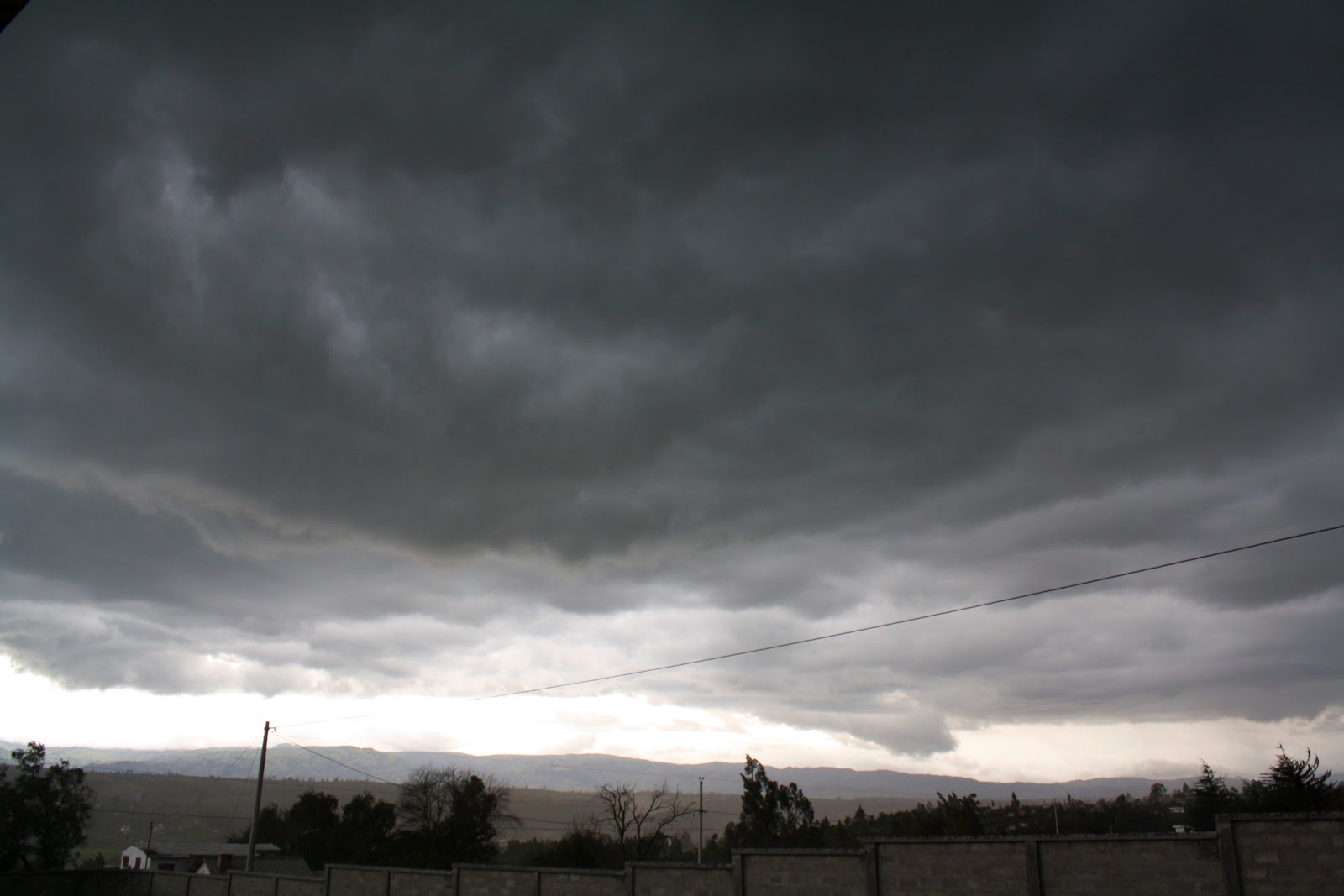
The clouds gained speed as they moved from the mountains in the distance closer to us. Weighed down by hours or days of moisture, their canopy seemed daunting. Slowly my mental thoughts cleared and my concerns of the day disappeared as all of my attention was taken by the storm above me. Every inch of independent anxiety was alleviated and washed away by the slow onslaught of the raindrops and the echoing thunder. Faster and faster they fell down onto the grass, drowning the dirt and pounding the pavement. This time I was safe under the awning, kept dry and alive to watch the incredible forceful throws of the storm surrounding me now. The thick clouds had moved over top of the orphanage and the smell of the rain made me smile.

It was sublime for a few minutes, especially when the hail came. I watched jagged edges of lightning cut the sky and break it for a moment. Thunder boomed its way into the distance and I watched the grass sigh, relieved that la tormenta had drifted.

Being driven to our hotel, we saw that the rain had managed to flood the roads, particularly a bridge that our taxi needed to cross, with water rising up into the bottom of the car. At the restaurant of our hotel the four of us shared a bottle of wine among our tiny sherry glasses and toasted to Valentine’s Day.

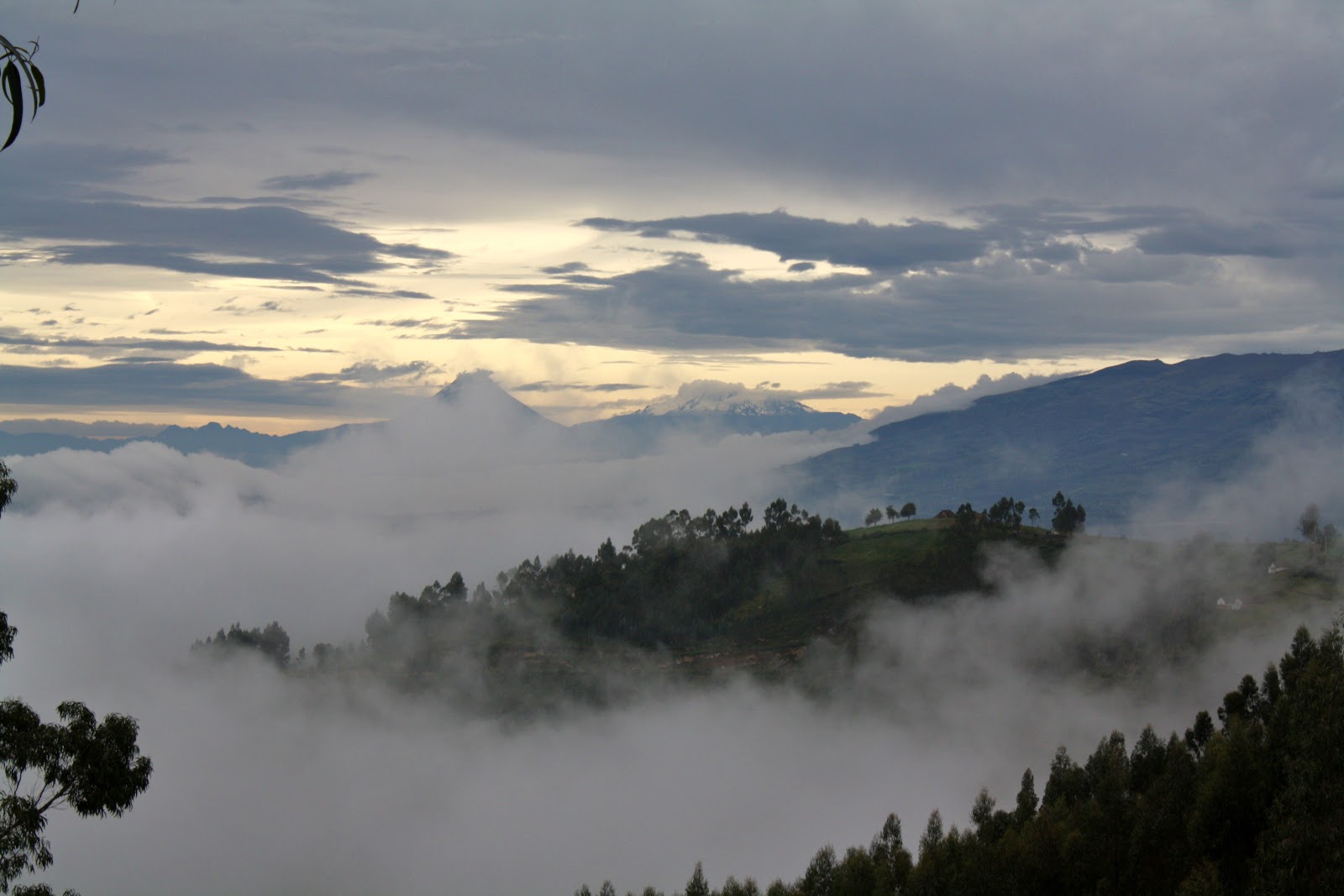
The next morning we rose early for our drive to a lake within a crater. We hired a driver who showed up with his little red truck and a camouflage jacket on. He drove us higher into the hills, above some of the low lying clouds. The volcano in the distance showed its face briefly but soon it was overshadowed by the moving clouds that slowly tiptoed their way in front. They drifted into the valley like ballet dancers, slow yet elegant in their sweeping powerful pointe work of pirouettes embodied with allegro and chassé.

Onward our truck took us, the terrain gradually becoming more divided in color and texture. We were now among the land of the indigenous farmers, their dry grass bound houses settled into the mountainsides as if it were a Shire. The bright pink or red dots marking the indigenous people with their colorful clothing often speckled the deep brown dirt.

Looking out my window, I remembered the glory of traveling. Here was a pocket of the world now made known to me, staring at me. We would drive straight for a bit and then curve sharply to the left or the right and the land would dip down and open up a whole other pocket of quilted farms, stitched together by people once escaping from the Spaniards. The shades of green below us and gray clouds hovering above us created a feeling of stillness. Alongside the road we would pass a couple of women wearing skirts to their knees, high socks, brightly colored shawls with long hair in a single braid wrapped with fabric and a panama hat on top. Half the time, they will have a baby wrapped onto their back as well.

We drove by one woman walking alone on the edge of the road. She was wearing a bright magenta shawl and stoically looking over the hillside at the expanse of farmland below her. I imagined her mind thoughtfully suspended in the air above her though her body was still walking around. Another woman we passed had a bright orange shawl and was herding sheep, lamas, and even a donkey all at the same time. Two more women worked the tilted black dirt up the hillside, one with a baby on her back. I wondered whether they felt satisfied.

Similar to when I’ve driven through the highlands of Scotland, I wish I could hear the stories of the land. In both places there is an eeriness that lingers in the air, alarming you that things have happened in these places even though it may be quiet and still now. The way the land showed itself with its colorful quilt, it was begging for quality time. I wish I could have lingered there a little longer.

The glory of traveling is wrapped up in the tragedy of leaving. But the fleeting moments can’t be stopped, they linger on and speed by as soon as you look up to see them.

Once we arrived at the crater it began to rain. The lake surprised me with its deep turquoise color as if someone had photoshopped and tweaked it to make it look more fantastical. But we only saw it for a moment before the rain chased us back to Latacunga.


Friday, January 21, 2011

Diga!

Speak!

Speak José! Speak!

I could see his mouth exercising, moving with so much power!

Speak!


Walk!

Walk Leslie! Walk!
I held her arms with my hands under her shoulders, while her feet stepped.

Walk!


Swallow!

Swallow Tati! Swallow!

As she came charging at me, I wiped her mouth with her bib, hugging.

Swallow!

I do so want to witness José’s first words. Sitting with him this morning, I would not relent, telling him, “Hola!” trying to show him how words were coming from my throat. I encouraged him to use his voice, pronouncing every word strongly, envisioning a breakthrough.

Prior to that I was helping little Leslie walk around the yard, up the wooden clubhouse ramp, over to the little wooden playhouse, and even down the slide covered in water droplets. I had a small desire to be a physical therapist in these moments.

With bravery, they move and try. Leslie quietly insisted she walk, happily stepping slowly and crookedly. José laughs instead of speaks and laughs the more that he tries, getting up and hobbling around the playground and inside the house. His fingers are bent and have calluses from him chewing on them instead of talking. But then I look at my bitten and destroyed nails and can hardly throw a stone at him.

It’s amazing to watch them try so much and so elegantly, without tears or anger, but with unassuming grace and having such a casual way about them. They’re becoming my favorite ones to see and work with, they’re smiles seem deeper knowing their disabilities.

The Tías show the same grace with the children, guiding them with understanding instruction and always telling the children how beautiful they are and how wonderful they’re doing. Words and support can grow such talented and intelligent children, despite the abilities they may not have been born with or the parents who have left them to themselves.

As Tati comes charging towards me, mouth hanging open, saliva dripping down in one long thin glob, I think,

Hug!

Hug, Sarah! Hug!

But it’s really not that hard to give hugs to kids with such wonderful smiles.

"Panama" Hats

We were mis-named
by our Panama canal engineers
Westerners who
thought we should be
Panamanian.

We are made from 
a special coastal reed
beaten and braided
wrapped with a colorful band
around the center.

2 weeks
to 6 months
it takes
to make us
expensive ones
costing up
to $1500.

Wear us.
Love us.
Let us protect you
calling us
Cuenca hats,
por favor.

Cuenca

Paint me a picture prettier than Cuenca and I’ll buy it and put it in my next house. Make sure you collage it with terracotta tile, marble cobblestone, concrete droplets, gauche, acrylic, newspaper and wooden pieces. Drizzle bright pink overtop, along with confetti pieces and marmalade. If you’ve picked the brightest colors, you’ll find yourself close to the beauty of this town. Before you give it to me, take a hammer and distress the wood, chip some of the paint and add some twisted metal pieces to the landscape.

Put a lock on the front, with a golden keyhole, as well.

In this town, eyes and feet rave about the colors and textures of the day. However, at night, doors close up, along with windows, leaving behind only echoes of footsteps and motorcycle engines, mixed with Spanish chatter from kids headed home from night school.

Locked up tight, she gets her beauty sleep.

Wednesday, December 15, 2010

An Opportunity

When your eyes are open just enough you finally see an opportunity rise out of the ground, on the horizon. Majestic and powerful, he will take you with him, lifting you out of the routine you've lived in for so long. Here he comes with his big wings spread, get ready to jump into his claws. He's not going to hurt you, but he may scratch you a bit because his claws are not very soft. Up you go, higher than an airplane or a rainbow, or a dream, he takes you, soaring through cumulus clouds and spots of orange sunset light.

Ah! His furry claws tickle a little bit, causing you to laugh as the adrenaline speeds through your veins, to your fingertips. You are almost flying yourself, yet helpless without his powerful wings navigating the sky. And he is beautiful, this creature that you had never imagined because your mind can't create to the extent that it ought to. His wings are bright blue with a stunning palette of shades, muddled with gold speckles and green splotches burning like embers in a passionate fire. The undercoat of his wings are all you see above you. His golden claws grip you and you hang, legs dangling like flower petals or leaves. you don't know what you did to deserve this ride, astounded by the new perspective you now have on the land. Its vastness overwhelms you, and how small it makes you feel, but how exciting is it all! You even let out a loud cry to the bird, attempting to communicate joy in the way you know best.

Hello world! How big you are! I am discovering you in every direction and all I can see are areas unknown to me.

And you don't want to close your eyes because the landscape is so glorious.

Turns out the opportunity has a destination in mind, unfortunately you can't be in the sky forever gripped in his royal hand. After awhile the ground begins to come towards you. The houses and people settle around you and you need to leave the opportunity's claws. Now the investigation begins. What is this new place and why does it feel so strange? What is strange about it? The adventure stops and you realize you have so much work ahead of you. Now you have to comprehend your surroundings as if it were a research project.

Where am I? Where was I taken? All I see are Xs and Ys and I can't seem to do the equation very well and don't know the answers.

And like research, you must be proactive and study. Set a hypothesis and find evidence or clues. Set goals.

As you live in this new place you find you are growing taller and you're surprised by how many sections of your brain had never been explored. You can feel them become alive like a lite-brite, forming different pictures of what you'd like to be, solidifying convictions.

All around you has become new and although you hadn't recognized it, you let it take you.

Saturday, November 13, 2010

Castles and Pockets

Harvard Square magically lights up at night like my old Polly Pocket kingdom.

Inside the heart-shaped plastic case I would find a tiny little castle, lit up streetlights and a princess. Tiny Polly stood in her plastic spot on the “ground”, next to her horse and carriage with the prince positioned into the yonder grass colored plastic.

What a creator I was, moving her around that little kingdom, not to mention her other “pockets”, including a kitchen scene, the beach, and a couple other house-like or neighborhood settings. If you google her name, you’ll see what I mean.

Intimate and intricate, these little settings grew an imagination in me. I could control Polly’s movements and create a storyline for her and her friends. One minute they would be in the kitchen, proceed to the living room, suddenly it’s bedtime, or perhaps a boy would knock on the door unexpectedly catching all the day’s plans off guard. Two friends might even get into a disagreement over who gets to ride the horse (whose stable happens to reside in the house as well).

But I no longer create a world for this plastic princess.

In my current world, I hit Harvard station at 8:21 and step on an escalator for 53 seconds, remaining to the right so the esca-walkers can pass me. At the top, a man with a weathered face offers me a Metro “newspaper” which advertises tragedy and gossip everyday. The two seconds it takes to reach out and grab it is too much. A second escalator lifts me out of the underground, focusing Harvard Square for me. Is it raining up there?

Raindrops sometimes sleep on the skylights above, snoozing off rising into the sky again. Sometimes the flaky snow is flirting with the wind, forcing me to bundle my jacket more tightly and ignore their careless dancing, though the romance makes me feel warmer inside. Other times, the morning light gently pulls up the corners of my mouth. Brick escorts my feet, while also holding up a homeless man and his dog, college students and magazine vendors. In the winter, Peacoated and North Faced people walk by me, while side bags and backpacks are hugging the backs and shoulders in the same way that children cling to their parents or ride their father’s shoulders.

Harvard University lights up like a scholastic castle once the sun has set again.

It’s one world that I see and at the end of the day I return home to another one. I tromp through the grass in the square in front of the Post Office. Far away from the scholastic castle I find rest in this place I’ve learned to call home. But for how much longer will that still be true. Both will be dropped soon, left behind as soon as I step on that plane.

The lid will be pulled down on both, with a strong clicking sound.

Sunday, November 7, 2010

Language Logic

I know a man who has one friend.

Does he honestly just have one friend, or does he have a friend? Maybe he really does have one friend (which would make him one/a lonely man). The misuse of a, an, the or one are pandemic among students, resulting in unfortunate shifts in meaning. Even more, if we want to talk about the man (that we just mentioned) a second time, we must specify by using the to point him out.

Prepositions are also complicated, as well as using count and noncount nouns. For example:

I brush my hair, not my hairs. I always enjoy milk in my coffee, not a milk, along with some sugar, not many sugars. My house has a couch, not just couch, and even more, that man up there - he doesn’t have friend, he has a friend (and maybe just one friend).

I hadn’t known those terms before I began teaching. Little do you know, but I just used the past perfect tense (had + past participle) which consistently blows students’ minds. I had eaten breakfast this morning and then I had gone to the train. Now, in that sentence the tense is misused, for we can only use it before another action that happened in the past. It’s more complicated than you had thought (right?). Perhaps it was more complicated than you had thought before you realized it was complicated. But more likely you just hadn’t thought it was as complicated as it is.

Often I find mistakes such as:

She have a sex mouth.
I am boring in class.
You went to the movies, weren’t you?
After Boston I come back to my country.
I am living in the Boston.

Have you ever thought about how “everyone” is considered singular? Or, why can we say “I go home” but can’t say “I go school”? How do we automatically know the difference between “it could be”, “it might be”, “it should be” and “it has to be”? How do we immediately know that “I considered to go” is wrong and that “I considered going” correct?

We also know that “read” in the past is pronounced like the color, yet “read” in the present is pronounced like the plant. We know that we ARE 26 years old, we don’t HAVE 26 years old. And even more astonishing, we can state perfectly that we are interested in, excited for, and are thinking about. We can recollect that we went to bed at 11, we didn’t necessarily sleep at 11. Moreover, we know that we can break up with a boyfriend, break out in a rash, break in new shoes, and even take a break when we’re tired. We also know that we’re tired, not tiring.

Modals, gerunds, infinitives, and the future perfect were all terms that I had no knowledge of before teaching grammar. But now I can confidently spew out all sorts of grammatical terms that would make any English speaker zone out. It’s like learning the inner workings of the human body, a car, or even mother nature.

But the major problem is that language is only mostly consistent. Students desperately desire to label grammar rules with “always” or “never”, but there are always exceptions and always things that they will never be able to express from their own language.

“We just don’t say it that way in English.”

That is all I can offer them, for any language must be learned purely as is. Constant translation only leads to frustration, as one tries with all their might to punch that language into the way they are most comfortable thinking. This is why children are the language prodigies. Their minds are so eager to absorb everything around them, the wires in their brains still malleable.

Each language is so closely tied to its culture and the unique way that each society thinks about things. English pops with so many different kinds of words that capture the tiniest contours and shifts in meaning. I could say that I am happy, or I could say that I am elated, excited, content, well-pleased, joyful, merry, cheerful or satisfied. Each would connote a different meaning and require an appropriate tone or context. Why do we have so many slightly different words for things? And as people have often noted, why only one word for love?

But even more than this, some things, in some ways, can often be more appreciated when taken as is. Rather than try to translate people or events into our own language of how we view life, and what they ought to mean, it is more meaningful to open the mind to possibility. Not flippantly, but in a way that helps release a creeping anxiety about the direction of our lives and the illusion of control. Sometimes life works differently than our limited understanding of it.

Yet, it’s difficult to be open when you believe that if you could figure out the rules, then things would click. In some ways, the rationalizing just needs to be turned down a bit.

An end. One end.
The end.

Saturday, November 6, 2010

The Entrance

The train ride lasts for 40 minutes, clicking and gliding northward along the coastline, between marshland and smoky cities, chugging itself through towns speckled with painted wooden houses, windows televising contented families with decorated living rooms; tailored window treatments, hemmed at the bottom, hanging peacefully next to a bright bay window dissected into four or eight sections. Retired chimneys are bricked upside the house or through the center, patched up and no longer smoking. On the front, sides, and back, porches have been stitched on, waiting for company. Yet winter quiets the streets, sweeping conversation inside around kitchen tables and putting people away into their living rooms, finding them curled up in blankets and next to their heaters. Meanwhile, the characters of nature take their place for the new season, directed to their appropriate corners and dots on the floor of the earth, some suspended in the air. Autumn drops her leaves until Spring can hang them back on the branches. Winter wanders in, staring at Summer falling asleep in the right corner. All things on the stage freeze as Winter takes a breath to speak.

Sunday, October 31, 2010

English Fall Mashup

Some trees have the leaves
Some trees no have the leaves
The leaves they fall in the ground
The leaves was feel
and to falling
down.

Any trees; they have the leevs
to be for color
The colors was felt
upon floor
between rocks who was put
next to one and one.

All in all, the fall is there
and here
and anywere.

The fall is live after the winter.

I like the fall.

Saturday, October 30, 2010

Chapter 1

This is my first chapter to a blog.

Once upon a time
there was a kingdom.

It was named Beverly
and rested on the North Shore
of Massachusetts.

Post adolescence
resided there.

They danced and played in their kingdom.

They worked and drank.

They made friends
and relationships.

Some moved on, some came back.

This is the story about one who is moving on.
And her travels here
and there
and beyond.