Showing posts with label nature. Show all posts

Thursday, July 14, 2016

Water and Words

Crescent Lake, Oregon

The other weekend ago we spent some time in the Crescent Lake area of Oregon.  I was surprised, yet again, by the turquoise blue water of the lake peaking through the trees.  How magical.  Nature never seems to let up, everything is so beautiful - even a rainy day.  When I think of lakes, I've always imagined the ones I know on the East Coast: muddy, green water solely navigated by the brave and the desperately hot.  I imagine leeches sticking to my feet in the muddy quicksand  and emerging with sediments still sticking to my sunscreen as I try to find relief in the shade.

At Crescent, we paddled on top of little waves - great practice for an inexperienced paddle boarder.  I wish I could've brought my camera; our dog looked so miserably cold - Why have you brought me out here???  She's our separation-anxiety dog and would've most likely whined on the shoreline or sniffed every person and food item available.  She was barely able to hold it together on that paddle board and nestled for warmth as necessary.  Poor puppy.

I love the outdoors and sometimes that is all I need - a run, hike, or beautiful experience.  Other times I need words and verbal or written perspective.  I really appreciated this poem I came across the other day:

"When I Am Asked"
by Lisel Mueller

When I am asked
how I began writing poems,
I talk about the indifference of nature.

It was soon after my mother died,
a brilliant June day,
everything blooming.

I sat on a gray stone bench
in a lovingly planted garden,
but the day lilies were as deaf
as the ears of drunken sleepers,
and the roses curved inward.
Nothing was black or broken
and not a leaf fell
and the sun blared endless commercials
for summer holidays.

I sat on a gray stone bench
ringed with the ingenue faces
of pink and white impatiens
and placed my grief
in the mouth of language,
the only thing that would grieve with me.


I don't read enough.  It's too hard and too easy to watch a show or movie instead.  When I do come across words that can make sense of something deeper, it is such a gift.  I've had those moments where I feel like the world has stopped, but it hasn't.  While my world has changed, the rest of it seems to keep on going.

I've had the pleasure of hearing some music recently.  We heard Neko Case, Laura Veirs, and K.D. Lang; Mandolin Orange - a sweet folksy duo with thoughtful lyrics and beautiful violin, mandolin, and guitar; and I stopped by Bend's downtown Summerfest to hear Blind Pilot play for free.  Thank goodness for musicians, who bring thoughts and words to life.  Although nature may be indifferent, people are not.  We are all much too affected by the power of each other.

Keep creating songwriters, poets, writers, and artists, just as the nature around us does the same.


Thursday, March 5, 2015

Biophilia/Biophobia

Almost that Spring evening light over the Beaver Pond. 

"Our annual melt is the wild, messy, glorious loosening of everything tight.  It is gravity's ecstasy, as water seeks its own level on every level, and the noise of water running fills day and night.  Down Ragged Mountain the streams rush, cutting through ice and snow, peeling away Winter's cold layers: rush, trickle, rush.  Busy water moves all day and all night, never tired, cutting away the corrupt detritus of Winter; fingers of bare earth extend down the hillsides; south sides of trees extend bare patches, farther every day; root-pattern rivulets, melting, gather downhill to form brief streams; dirt roads slog and driveways turn swamps.

Then it dries; last snow melts; trees bud green; soft air turns. Who can believe in Winter now?"

Donald Hall, Seasons at Eagle Pond

What a specific and glorious depiction of thaw.  It reminds me of the consistency and longevity of the seasons - how they smell, look and feel for us.

In my Theory of Adventure class the other day, we were discussing Biophilia (what?). This is a theory that holds that people have innate responses to nature.  There are nine of them:

Naturalistic - You can benefit from nature mentally, emotionally, physically
Dominionistic - You like to be challenged by nature and overcome it
Utilitarian - You use nature's resources
Negativistic - You are afraid of nature or don't like it
Symbolic - You resonate with spirit animals and symbols from nature
Humanistic - You have a relationship with nature
Moralistic - You feel we all have a responsibility to care for nature because we all belong to it
Aesthetic - You think nature is beautiful and benefit from flowing water, bubbling brooks
Scientific - You study nature in order to use processes to human life

It was easy to talk about how great it is to be Naturalistic and Moralistic about nature.  We even took tests which showed as a class that this is where we stood: Moralistic, Naturalistic, Humanistic and Aesthetic were somewhere around the top while Dominionistic, Utilitarian, Negativistic and Symbolic sank to the bottom.

We talked about other cultures that may identify these bottom values.  People who use the land all the time, are aware of the natural elements (and fearful of them), and work to have dominion over their land.  Farmers and people living in "developing" areas that depend on the natural resources around them and hope for good weather may share these responses.  We talked about fisherman who are famous for superstitions about the sea.  They hold to certain rituals in order to be successful, in a symbolic way.  But the conversation also shifted to how often these kinds of people do care about the land.  What I thought about in my own head was, "Probably better than we do."  People who live in it know how it can be; they are tied to it in a way that we forget.

As Outdoor Education students, we pride ourselves on cutting edge gear to deal with the outdoors, buy stoves so we can "leave no trace" in the wilderness, or invest in water-resistant tarps and tents for nastier elements.  Our sleeping bags can keep us warm in freezing temperatures and our backpacks are gorgeous.  These items all come from nature somewhere down the line - even Gortex - and we own so many of them.  They're probably from Taiwan.

We are so removed from so many things.  Many of us are removed from nature enough so that we can choose when we want to be in it and when we don't.  The moment the heat or the electricity go off in the winter, then we are brought a little closer to the reality of resources.

It's okay to live in houses that are warm and pride ourselves on technological advances.  But let's not forget how long it took us to get there and why we did - through generations of humans.  I believe that the presence of healthy fear can mean there's a space for growth.  I think if we're honest, we'll find how deeply terrified and awed we are of our ever-changing natural world.

I wonder how we can keep that fear alive.

Monday, October 7, 2013

Black and White


"I am losing precious days.  I am degenerating into a machine for making money.  I am learning nothing in this trivial world of men.  I must break away and get out into the mountains to learn the news."  John Muir

I drew a picture of autumn in my Human Behavior class, just like I used to do back when I was in undergrad: make paint drawings on my computer.  Only this time, I also talk in class and contribute, because I actually have thoughts to share and questions to ask.  My professor was talking about race and explaining the process of children coming to an understanding of it, but she spoke like an outsider, as if she was raceless rather than white.  My class has zero diversity, in terms of color: we are all white.  But why didn't the conversation open up to what that means to people?  Did you always know you were white?  I didn't really even know why race was even an issue until I was older.  I had grown up in such a homogenous community, I didn't even really understand why prejudice existed.  People were people.  Isn't this why Stuff White People Like was developed?  Because some white people think they have no culture?  Then I go on that site and every new thing he adds, I think, "I love that!".

I used to think, when I was little, that if people would just stop referring to each other in terms of color, all those issues would go away!  What was wrong with people?!  And why were there two political parties?  Wasn't there just one correct answer to every problem?  Shouldn't these people be finding that answer?  Why would you support the wrong answer?

I also thought that the world had actually existed in black and white at one time, from watching black and white movies.  I remember staring out the window at all the grass and trees, asking my mom, "So when was color invented?".  I also thought God wrote the Bible and dropped it down from the sky and that the rest of the world lived in chains because my teachers kept telling me to be thankful for the freedom that I had.  I pictured everyone else in the world living in black and white still, in prison, and starving.  And I also thought I was a pretty smart kid.

I'm glad I don't think those things anymore, but the learning never stops.  One of the most frustrating things, in my social work classes, is to hear classmates ask questions such as, "Why is immigration so hard?  I mean, my grandparents came over here and worked."  There is just so much I want to respond to that I have to focus on containing myself and remember that we are not on the same page.... maybe even not in the same book.  I will limit myself to one reasonable comment given without an inkle of outrage... hopefully.

But am I learning nothing in this trivial world of men?  Sometimes, I do want to flee to the mountains and get away from having to converse with those whose ideas don't expand my mind in ways I'd like.  But there is always something to learn, even if it's how to hold my tongue and refrain from exploding over the myriad of challenges faced by all kinds of immigrants and how.....

I will finish my drawing of the woods.


Tuesday, September 3, 2013

Out of the Flames

14 years old, Camp Susque, Look Out Mountain
We were told, at the camp I went to, that it was started around a fire - a few men sitting around, talking, and contemplating how staring into the flames opens people up.  That cackling orange that starts out small and slowly builds, eating up all of the materials in its path, becoming bigger, roaring, and welcoming you.  Your face and hands are warmed, trickling down to your feet.  The attention is no longer on you or anything else; the fire has eaten that, too.  People might even start singing in front of each other.  Stories are shared, thoughts and questions are thrown around, or people might just stare and stare into the mysterious combustion happening in front of everyone.  

The other day I had the rare opportunity to facilitate ropes course activities and then fire building.  This was one of the tasks that my group of 13/14 yr old girls (8th graders) had to do as a part of a SHIPWRECK initiative where they imagined they were stuck on an island and had to save themselves: build a fire to boil water, catch a couple fish in the pond, build a shelter that can cover one person, and create an SOS signal.  

So, when you light the match, you really want to put your hand around it to protect it from the wind.....  
No, not on top of it.  See what happened?  
See, the flame will go up and burn your hand... 
You also want to find lots of little thin brush to feed the fire... 
Birch bark is a great fire starter.... 
What do you think?  Do you think you can rest the pot on those sticks?

They had no idea what they were doing.  Sticks were piled on top of each other, live branches were brought over, green leaves and grass were some thoughts for fire starters - so I threw in some tips...  

So, really what you want to do, is make a teepee inside a log cabin...
Remember, the fire needs oxygen, so make sure you create some space...
You guys have the extra challenge of wood being damp today...
Dirt will kill your fire, so it's good to brush it off the bark...

Fire ties most of my favorite memories together.  There is something about those flames that reconnect us to the mysteries that surround us, the power that exists, our ability to create, and the importance of our history.  Fire has caused me to stay up until the early hours of the morning getting to know people, reconnect with old friends, or celebrate a new year.  Shabbat was celebrated through dance around a fire on the shores of Lake Victoria, travelers were met in the desert of Chile, and Hogmanay (new year) was celebrated in a village in Scotland, or friends were made, for life, at camp.  

"The tendency to wander in wilderness is delightful to see.  Thousands of tired, nerve-shaken, over-civilized people are beginning  to find out that going to the mountains is going home; that wilderness is a necessity; and that mountain parks and reservations are useful not only as fountains of timber and irrigating rivers, but as fountains of life."  John Muir, Our National Parks, 1901

Imagine what Muir would say now, since he considered people over-civilized in 1901.  The faces of the girls who made that fire revealed some of that joy that we are inherently prone to when building a fire, riding an ocean wave, arriving at the top of a mountain, or gazing up at the stars.  Our identity is not in our computer, phones, or cars that we buy, but out in the natural world.  I suspect it's because we didn't create it, and therefore, it will never cease to fascinate us.  Imagine what happens when we separate ourselves from it for too long.

Campy, Kumbaya, touchy-feely, bonding moments, heart to hearts... in our culture, we tend to use these words in order to make light of an experience.  But isn't this what we actually want most?  Don't great ideas come from these experiences?  Don't we feel most connected to others during some of those moments?  Why do I have to explain through research why nature or adventure experiences cause change in people's lives?  How did we get so removed from where we came from and what is that doing to us?

"I am because we are."  I learned that in Uganda, a culture that often thinks in terms of it's community.  I think the pull of the fire, that naturally causes people to make a circle, converse, and be present with each other, reminds us that we don't exist only because we think - we exist because of other people, because of connection, relationships, and this world that let us in, and if we don't maintain our connection with each other or that world, we begin to be alone with our thoughts and become isolated in a chaotic and confusing universe.

"...the human species had become 'autistic' in the way they relate to the natural world.  The origin of this autism is reasoned to be associated with Descartes' notion of mechanism.  Derived from Cartesian dualism, in which mind and body are perceived of as clearly distinct from each other, mechanism is the doctrine that all living things are in essences just machines... Nature was viewed as a machine with working parts that could be dissected, explained and understood... People have become deaf to its voices, stories and sources that nourished their ancestors in primitive societies."  Thomas Berry, 1988

Our thoughts are not enough, it takes a fire to pull us out of ourselves.

Students the same age as me in the above photo, getting ready for 9th grade at La Vida, ADK (2011)

Friday, August 2, 2013

The Great Salt Lake

Down the Street
"As you say, I knew I wanted to make a change from the previous urban landscape work I'd been doing, and I was keen for a new kind of challenge. I'd been curious about forests for a variety of reasons: their importance as linchpins of biodiversity, the role that their destruction has played in species extinction, and the magnificent way that vast, lush, unpeopled stretches of wilderness can remind us that life extends beyond the world of human development and time, and that that is, in fact, the point from whence human life evolved.

Robert Adams once said that what photographers are often doing is trying to find a good example of something they already know. That is one of the essential tasks of photography: to recognize those salient facts which can become a vehicle for metaphor.

That's my ambition right now. To take what I've learned as a photographer and a human being, and see how much of that I can put in to pictures. It's a great challenge.

Richard Rothman Stanley, Ahorn Magazine

Salt Lake City. Dry, hot, hilly, and hot-pressed into the mountains like a panini. I could fry an egg on the sidewalk or pavement, but I haven't tried. The sun bakes my whole body when I move around the city, yet in the shade I can sport a sweater and pants. When my sweat mixes with my dry hair, it gives it that I-just-swam-in-the-ocean soft stiffness that crunches when I try to put my fingers through it. My eyes are dry and I drink five gallons of water a day plus a drink or two. A cool breeze is blowing just now and the air feels absolutely weightless.

The grass in front of me is green because a lawn sprinkler waters it for an hour each night. In the back it's all dried up and looks like Mexico. I am sitting on the porch of a house on a street with a 90 degree incline. Descending it on my bicycle was terrifying. There is a Vespa in the driveway that is still waiting for me to ride it, which I WILL do once I work up the courage.

I met two gold diggers from Nevada at the local brewery last night. That's right - Nevada, and yes - geologists who ACTUALLY search for gold, send it to refineries, and have it turned into whatever people want it to be. They had already had a bottle of Jim Beam before the bar and were headed to a concert. They insisted we go, but we were already headed to see The National, who played in the park for five freakin dollars. Sitting on my friend's husband's shoulders for the last song was thrilling. It was my third time seeing The National, not particularly intentionally - he just always seems to show up whenever I'm travelling. Once in Santiago, Chile, then in Providence, and now in Salt Lake City. He feels almost like my musical, troubled, alcoholic traveling companion.

Does America realize that Utah is hogging most of the country's beauty? There is no shortage of amazing natural wonders to see in this state. It's ridiculous. Just look up pictures of Staircase Escalante, Devil's Garden, Sunset Arch, Zion Narrows, Coral Pink Sand Dunes and you'll see what I mean if you don't know what I'm talking about already.

Being out in such an expansive wilderness always does tend to illuminate the reality that life extends farther than our eyes can see and our minds can comprehend. There's a huge intricately woven complex world, planet, solar system, galaxy, history, genealogy and evolution that we are all members of. There is nothing new under the sun, just different ways of molding and innovating what grows there. The projects, tasks and innovations that are sometimes clung to so tightly will never fulfill anyone in the way that things unseen can, yet it's a challenge to try and capture those salient factors, but that is the above photographer's take on his own work. I think it's mine too, whether that be in writing, pictures or photos, in order to do what Robert Doisneau, that awesome French photographer, stated:

"The most beautiful and simplest reflex of all is the spontaneous desire to preserve a moment of joy destined to disappear. The act of quickly trying to capture the fleeting moment is more calculated - an image to prove one's own world exists."

Power Line Outline
Blue on Yellow
The Ten Minute Crossing
Hello Brigham Young
View from a Bicycle

Thursday, July 25, 2013

Mad Happiness


I began to notice of look of horror come over Meredith's face as we were finishing up lunch in a cafe downtown.  I turned around to see through the window oceans of water being released from the heavens.  We had no choice but to run through them, since there was a meeting she had to return to at work.  Completely unprepared, except for a take-out container that Meredith decided to use as a hat, we opened the door to the street and began sprinting through the sheets of rain.  We were SUCH renegades.

There's a quote that I've always loved from Nine Hills to Nambonkaha that says, "Rain is living breathing happiness.  Mad happiness."   It does feel like crazy joy when you embrace the rain, screaming and zigzagging through the streets - even barefoot (just one of us).  You are reminded that you're living, you're breathing and that it's nice to feel a little crazy sometimes.

Friday, July 19, 2013

Breath of Salty Air


(Rockport, MA.  Memory card was left at home, but this is an exact replica)

"And then, some morning, the mind wakes, comes to life again.  Not in a city sense - no - but beach-wise.  It begins to drift, to play, to turn over in gentle careless rolls like those lazy waves on the beach.  One never knows what chance treasures these easy unconscious rollers may toss up, on the smooth white sand of the conscious mind; what perfectly rounded stone, what rare shell from the ocean floor.  Perhaps a channelled whelk, a moon shell or even an argonaut.

But it must not be sought for or - heaven forbid! - dug for.  No, no dredging of the sea bottom here.  That would defeat one's purpose.  The sea does not reward those who are too anxious, too greedy, or too impatient.  To dig for treasures shows not only impatience and greed, but lack of faith.  Patience, patience, patience, is what the sea teaches.  Patience and faith.  One should lie empty, open, choiceless as a beach - waiting for a gift from the sea."

- Anne Morrow Lindbergh Gift from the Sea

Lawn Chair


Someone get this guy a drink, he's been sitting out in the sun all day.  Or bring him an ocean, a friend, and some music.  At least he can munch on some blueberries while waiting for someone to want to sit outside again.

Thursday, July 18, 2013

Conditions


The heat has been brutal lately.  I've been exposed to the elements for the past three days now, being out on ropes courses.  All I can think is, "Survive, survive, survive."  It's worth it, in the end.  I like to think I'm embracing nature despite its attempts to destroy me.  However, I would like to drag an air conditioner along with me, as if that would help cool down such a gigantic section of air.  But then, there'd be no struggle for survival and I would forget that I'm human.

Friday, April 20, 2012

Whales

My Easter bonnet was almost a wooly hat, had it not been left behind by my North Face jacket walking out the door.  On the sand, next to the water, we sat on rocks and read from the common book of prayer those exaltations designed for each and every occasion. 

Put far from them, every root of bitterness, the desire of vainglory, and the pride of life.  Fill them with faith, virtue, knowledge, temperance, patience... Turn the hearts of the parents to their children, and the hearts of the children to their parents; and so enkindle fervent charity among us all, that we may evermore be kindly affectioned one to another.

That book uses words we've left behind.  The silver sea lay below thick clouds whose strength forced us away.  Snowflakes were coming down.  Though flowers had already begun to bloom, they were the only sign it was April. 

Later, I let an egg sit in blue dye.  I imagined the small white specks as constellations, as if it were a new universe.  Thinking of the universe reminds me how tiny we are and how there are whales below the water.  If there are whales below the water, I can only imagine what else I don't know is out there. 

Sunday, October 9, 2011

Sea

There it is.

Water,
soaking space
between land and shore.

sweeping
stilling
sleeping

drifting under sky
sinking blue sighs

exhaling.

I can't tell you how much I love seeing you.

Wednesday, June 1, 2011

The French Astronomer

In the desert, the consistent nights of clear sky provide the perfect conditions for star gazing. The sky takes over the landscape, stretching out so expansively over the sand and mountains, reflecting nature's brightest blue. At night, the sunbeams quickly clamp themselves down over the mountains, slowly shading in the shadows with purples, reds and pinks. It all happens so fast and without any cloudy interruption, causing the colors to really streak and paint the sky so artistically. I can’t capture it with my camera; I’ve tried. Fortunately, I purchased a polarizer before I arrived here, which has helped immensely in photographing just how blue the sky is.

We booked a tour of the constellations and hopped on yet another tour bus, this one filled with English speakers from all over. A French astronomer greeted us out in the middle of the desert and led us out into the sky, everyone in their newly purchased alpaca hats with the native patterns of swirls and animals on the outside. For myself, I wore my newly purchased colorfully checked hat that has the animal fur flaps that clip over your ears and flip up in the front, very stylish.

He began by noting that viewing the sky is about observation. As the stars are moving, we are moving, and our cultures are also developing and changing. Perhaps the natives in the past were a little trippy from the substances they smoked from desert plants and perhaps the missionaries were trying to convert people by converting the constellations to Christian images. With his laser he pointed out squares or diamond constellations that are seen as a centaur, scorpion or an alter.

“As as you can see here, this is bear. Here is the head and the body, right? Obviously. Well, if you thought that was a bear then you probably would think that over here is a woman. As you know, all women have square heads. But a Virgin? I don’t think so.” He said as he pointed out the constellations that formed two stretched out legs. “Now, if you’re a European this bear now becomes a saucepan or a big dipper. And over here, if you have a monarchy, you would see this as the Northern crown, but if you are perhaps a Communist, this now becomes the sickle.”

“If you’re a Christian you would see this as a cross. Why they chose to use one of the most horrible ways of death, I don’t know, but the Barbarians – they didn’t have this way of killing people, so they saw a kite. People from Patagonia saw a hand and other indigenous saw an arrow. And over here we have a constellation very intelligently named, well, what do you think?” he said as he used his laser light beam to point out three stars 45 degrees away from each other.

“A triangle,” answered someone.

“Yes! As I said, you are a very educated group. But as you can also see, I know many triangles in the sky,” he said, proceeding to connect all different dots to make triangles.

“Now, if you could make a list of your top ten favorite things of all time to do in your life, they wouldn’t be things you learned in school, would they?”

“Triganometry.” piped up someone from the crowd.

"Astronomy is one of those things you will never learn in school."

“I will show you the astrological signs, but I don’t think they really have much meaning. The stars don’t really care about us, and for astrology to be correct they would have to have meetings, figuring out whose birthday was when and then decide to do mean things to people. Well, if you’re boyfriend breaks up with you, and you follow astrology, then he probably was right to do so.”

“What are the five best things to do in life? Breathing, eating, sleeping, drinking and…..? Sleeping again.”

“What do you have to do before you have a baby? Well, you have to make them. And you may need to try one or more different people before you find someone special. Well, watching the stars provide the perfect conditions. Imagine: it’s cold, you’re looking up at the sky. I’m telling you, it’s perfect. There is a closer distance between you, unlike playing tennis or some sport together – these are not going to do the trick. But how do you point out the constellations? Well, you don’t get a laser. What you do is with one hand point out the star and it’s really the other arm that is doing the important job,” he said as his other arm demonstrating pulling a person closer to him, “and don’t just repeat information that you read on Wikipedia, that is not going to work.”

He proceeded to spout off toneless facts about the age of different stars and how far away they are in the sky and then imitated a girl politely creeping away. Then he informed us it’s possible that she could be a nerd too and natural selection would take over the situation.

“You see, to get to the closest star would take 385 generations of humans. So, if you were to take 4 humans, put them in a rocket, and send it off at the speed of light, it would only be the 385th generation that would make it to that star – and you can imagine by the time they got there they would be a little deformed. Perhaps they would have three legs, green skin, and speak in a strange voice. So, whenever you see extraterrestrials on earth, remember that when they began their journey they were actually quite normal looking humans.”

Photography is actually able to capture stars that our human eye can’t take in. He took some of our cameras and set them up to expose for 30 seconds in order to show this. Now I am happy to have a beautiful picture of the night sky. There is an image via the Hubble Ultra Deep telescope that was about able to capture about 2,000 galaxies in an area that is about 1/12 of the moon, the image exposing for 12 days. If there are that many galaxies in that small of a space, imagining how immense our universe is reminded me how very tiny I really am in comparison.

In the beginning of our tour, there was a star over in the East just above the mountain and by the end of the tour it had moved up a good ways, as the earth had been rotating ever so slightly the entire time. As the Earth tilts and rotates, the Southern hemisphere can see certain stars, only sharing about 2/3 of the sky with the Northern hemisphere at a time. The Milky Way surrounds us, and as our guide pointed out, when you see the Milky Way through a telescope you’ll notice that it’s not actually milk but a thick clusters of stars.

“And as everyone knows, people in New York actually walk like this,” he said, demonstrating a person walking at an angle.

It would take 8 minutes at light speed to get to the sun, our closest star. The planets are found within a certain band across the sky but can be seen in the different places over the years as they move along their course and sometimes they align in different ways. As they move, they also find themselves in different astrological signs, which astrologists try to interpret. Saturn in Virgo…. Mars in Scorpio… etc, etc….

“At the beginning of the month, there was an alignment with some of the planets but it wasn’t a great one because the Pope didn’t die. As you know, whenever there is a planetary alignment something catastrophic always happens – a Pope or King dies, etc. In 2040, Mars, Venus, Saturn, and Jupiter will all align with the moon and that will be the end of the world,” he informed us, ever so sarcastically.

“Now, how do you read a star map? Well, the best source is actually your I-pad, which has GPS and can locate exactly which sky you are in. Then, you want to find the Southern Cross. As you can see, I know many crosses, “ he said as he made different cross constellations with his laser and all different stars in the sky, “but if you read a map it will have the constellation drawn out with a helpful label, ‘Southern Cross’.”

“What you have to remember when looking at the sky is that we’re looking at the past. We receive the light of these stars many years after they have actually formed. See that star over there? The light from that one left when you were born. We are looking at basically the same sky that people did hundreds of years ago. The stars move very fast, but in our sky, this one for example, has only moved from here to here,” he told us, pointing out a very small space in the sky.

We saw a shooting star (or, falling rock burning up in our atmosphere) during the beginning of the talk and he informed us that two others would be included in the tour. He took us around to different telescopes where we were able to see nebulas, globular clusters, the Milky Way and even Saturn. The view of Saturn was actually quite strange because the white silhouette was an exact replica of my glow-in-the-dark stickers that clung to my starry sky ceiling when I was younger. It was a stark white clear cut-out of Saturn, with its satellite to the left brightly shining. I suspected that perhaps it was in fact just a sticker by its artificial nature.

After the tour, we went inside for some hot chocolate. We were actually in his house, though the center room resembled more of a dark adobe gathering place with tiny lanterns hanging from wooden posts. The bathroom was actually very excellent, with a lampshade around the center light with a starry space scene, hot tub in the corner, and colorful and artistic touches in the mirrors and soap dispensers.

He’s been doing research on asteroids out in the desert, funding it himself. His knowledge and exuberance for astronomy was inspiring, especially in that he made it fun for us to view and listen to. Being out in the middle of the desert wasn't so bad either, those stars are quite the spectacle.

Tuesday, May 10, 2011

Patagonia

No, I didn’t go there and nor will I. Sadly, the area is entering its winter and Rosario and I thought the desert would be more amiable. Therefore, we settled for San Pedro de Atacama instead.

But: Patagonia. A battle has landed on the streets of Santiago over the best way to energize the country. The land is long and thin, with every kind of climate from North to South. They have possibilities: wind, nuclear, solar or hydro-electric – and what the politicians have sided with is the hydro-electric, which will impact the beauty of the Patagonian territory.

Endesa is an energy company that creates these structures, while Transelec is a company that figures out how to get the energy from there to the distributor. Both of these companies are clients of my institute; Endesa actually being our major client. The situation made for investigative conversation today.

What struck me was how easy it is to demonize companies, when really, no one wants to destroy Patagonia. The other week, two managers of Endesa spent our time telling me all the places I needed to see in Chile, promoting Patagonia immensely. One manager was recommending taking a trip on a boat there, taking me to a glacier along the way, just like he did years ago. He was looking up the information for me and giving me the name of his friend who works for a travel agency.

The problem is, in order to develop, one needs energy. However, if people really want, they can protest that Patagonia be removed from the list of places they can obstruct. Or, can they? At the moment, 60% of Chileans disagree with this decision. Can they create enough commotion to actually redirect the rationale behind this decision?

Usually money wins these types of things. Highly-paid people sit down and reason out all the options, finally settling on a practical or lucrative direction for a country. But what if Chile didn’t even own the Patagonia area? What if people could protest enough to just eliminate this prized possession from the running – and force politicians and CEOs to find another way, because they have to?

Finding another way is the challenging part. Chileans saw the destruction of Japan, instantly reminded of their own possible fate if they were to build a Nuclear power plant. The technology and money doesn’t exist here to build solar panels in the desert, as it does in California. At the moment, coal is the most popular resource in use which also causes more local damage. Perhaps the hydro-electric option is the best, or seems most justified – being clean energy, but yet, it sits in such a beautiful sanctuary.

However, I am very demanding – sitting here between two laptops with the light on and an electric heater warming my feet while an electric blanket warms my bed. I arrived to this country via jets and use public transportation everyday. I like cooking my food on a stove, washing my clothes in a machine, and refrigerating my food. Often I forget a cloth bag when I go to the grocery store and I enjoy taking warm showers. Though most days the mountains are barely visible due to a thick layer of smog and I know that babies sometimes need the dirt from the air cleaned out of their lungs, I wouldn’t recommend living in the dark or going back to the days of just walking from place to place.
But…. Patagonia? We're going to mess with Patagonia?

Friday, April 22, 2011

Ambiance

Throughout my life, my energy has come from trees and sky, stars and open ocean expanses iced with wind gusts and sailboats bobbing on top of the water. Half of my life has been comprised of weekends chopping firewood for our wood burning stove, summer evenings inhaling the scent of cut grass off the freshly trimmed lawn or riding my bike through walls of humidity while listening to the crickets and summer peeps, skidding to a stop on the dirt lane. The crab apple tree in the center of my yard contains a stump in the middle where I would sit and write in my journal lofted above the yard while Friskey would lie out on a branch nearby. Even within these moments, I knew I was actually painted on a page of a storybook.

When I needed to think, finding myself in an empty kitchen after school, I would head to the woods and journey through the dead leaves and moss covered ground, trekking down to the swamp below my house or through the backwoods down my lane. In the winter time, parts of the swamp would freeze over, solidifying curvy narrow ice paths where my brother and I could slide. Runs to White Lake or down Slabtown Creek Road beneath shadowy tree trunks bursting with color characterized all seasons, the winter appearing in grayscale. With my first decent camera, I would take pictures of the sunset or photograph the tree tops for hours, the hard copy pictures now slowly bending in crates in my basement.

The silence slows steps and escorts you carefully into the quiet of the woods. They are very much alive, yet largely still. The trees continue to grow soundlessly; micro-organisms in the ground crunch with their mouths closed and only the occasional squirrel or bird making a swift move up the trees or over to neighboring branches can be heard. Alone on a hilltop or farmland edge I would sit and wait for some kind of miracle or inspiration to come, to write something genius in my journal while following the moving clouds with my eyes.

Fresh air rarely filters through this new metropolitan realm. Silence is elusive, found only within my apartment and sometimes creeping along darkened sidewalks or tiny side streets. I try to walk with it, but it runs away to lock itself away for me when I get home. People inhabit every corner surrounding me, carrying conversations, walking hand in hand, moving in vehicles or peddling bicycles. Grassy park commons and fountains painting rainbows in the air outline the city with nature, which I relish. Food and clothing come packaged in tasty styles and decorative wrappings, trimmed with articulate architecture and ancient materials. The city is a fabric of pockets which have been stitched together to form neighborhoods and districts, galleries of the wealthy and poor, laid out among towering structures that climb into the sky, exhaling their innovations and economy throughout the country.

From my bedroom window, the mountains watch me from a distance as I eye the orange sun setting itself along their backbone. Once gone, the moon comes through the black canopy, with a few starry escorts, brightly shining.

To compare the two just wouldn’t be fair.

Friday, February 18, 2011

Fleeting Rain, Passing Quilt

Two bus rides and three hours later finally landed us in the town of Latacunga. We walked along patches of sidewalk by men draining liquid out of machines, a man within the hood of his tractor trailer, people on bikes carrying carts of supplies, stray dogs wandering, and a woman washing her clothes in the concrete basin outside with a view of the patchwork of colored houses across the valley. The sun was actually on our backs as we walked closer to the center of town to find a taxi. From there we were driven to the orphanage constructed of one building situated in the countryside.

Soon enough I had a sleep pile of two toddlers sitting on my stomach and legs. The playroom was spotlessly clean and quiet music played in the background as baby Joanna wrinkled her nose against a stuffed animal duck. Meanwhile Sarita investigated my dirty shoes but I quickly pulled her away. Soon the Tia came in to herd them all to their respective high chairs for dinner.

I stood outside as the clouds increasingly grew black. In the yard I taught a couple little boys to blow the remains of a dandelion into the air. One of them, Carlos, rode around on his tricyle. Eventually they began heading inside, missing the beginning of the show that was about to take place. Carlos called to me to come with him, but I couldn’t take my eyes of the natural stage in the sky.

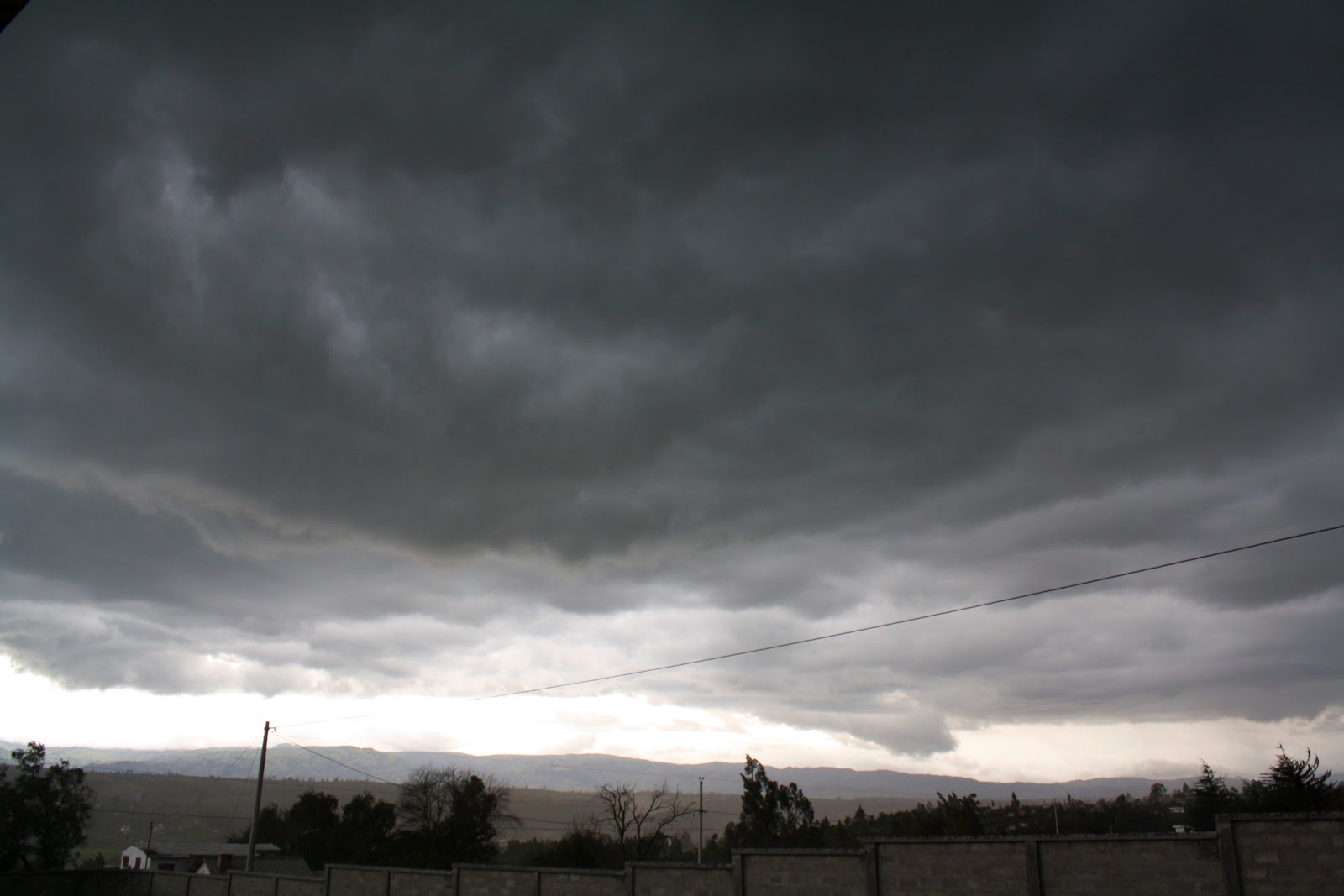
The clouds gained speed as they moved from the mountains in the distance closer to us. Weighed down by hours or days of moisture, their canopy seemed daunting. Slowly my mental thoughts cleared and my concerns of the day disappeared as all of my attention was taken by the storm above me. Every inch of independent anxiety was alleviated and washed away by the slow onslaught of the raindrops and the echoing thunder. Faster and faster they fell down onto the grass, drowning the dirt and pounding the pavement. This time I was safe under the awning, kept dry and alive to watch the incredible forceful throws of the storm surrounding me now. The thick clouds had moved over top of the orphanage and the smell of the rain made me smile.

It was sublime for a few minutes, especially when the hail came. I watched jagged edges of lightning cut the sky and break it for a moment. Thunder boomed its way into the distance and I watched the grass sigh, relieved that la tormenta had drifted.

Being driven to our hotel, we saw that the rain had managed to flood the roads, particularly a bridge that our taxi needed to cross, with water rising up into the bottom of the car. At the restaurant of our hotel the four of us shared a bottle of wine among our tiny sherry glasses and toasted to Valentine’s Day.

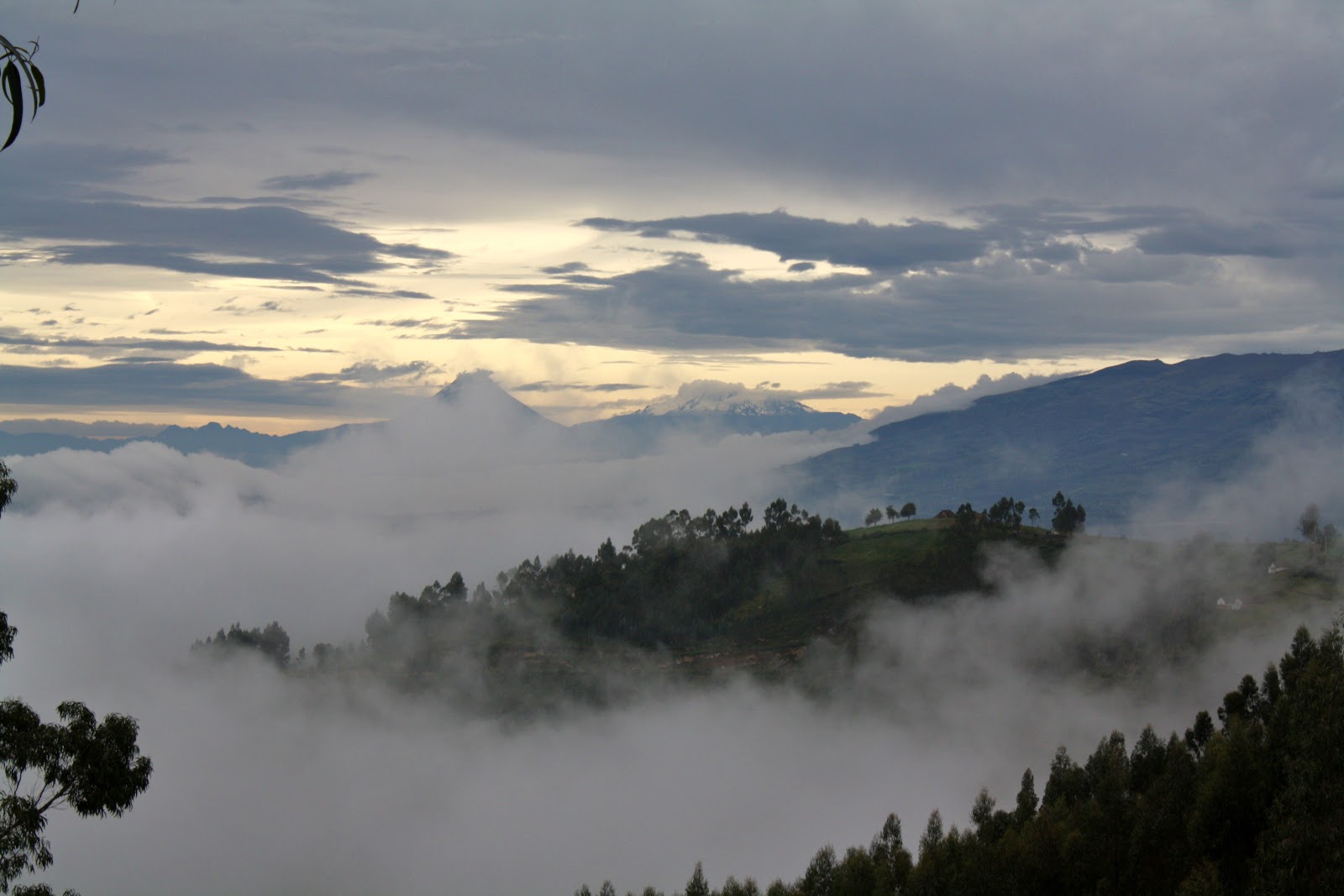
The next morning we rose early for our drive to a lake within a crater. We hired a driver who showed up with his little red truck and a camouflage jacket on. He drove us higher into the hills, above some of the low lying clouds. The volcano in the distance showed its face briefly but soon it was overshadowed by the moving clouds that slowly tiptoed their way in front. They drifted into the valley like ballet dancers, slow yet elegant in their sweeping powerful pointe work of pirouettes embodied with allegro and chassé.

Onward our truck took us, the terrain gradually becoming more divided in color and texture. We were now among the land of the indigenous farmers, their dry grass bound houses settled into the mountainsides as if it were a Shire. The bright pink or red dots marking the indigenous people with their colorful clothing often speckled the deep brown dirt.

Looking out my window, I remembered the glory of traveling. Here was a pocket of the world now made known to me, staring at me. We would drive straight for a bit and then curve sharply to the left or the right and the land would dip down and open up a whole other pocket of quilted farms, stitched together by people once escaping from the Spaniards. The shades of green below us and gray clouds hovering above us created a feeling of stillness. Alongside the road we would pass a couple of women wearing skirts to their knees, high socks, brightly colored shawls with long hair in a single braid wrapped with fabric and a panama hat on top. Half the time, they will have a baby wrapped onto their back as well.

We drove by one woman walking alone on the edge of the road. She was wearing a bright magenta shawl and stoically looking over the hillside at the expanse of farmland below her. I imagined her mind thoughtfully suspended in the air above her though her body was still walking around. Another woman we passed had a bright orange shawl and was herding sheep, lamas, and even a donkey all at the same time. Two more women worked the tilted black dirt up the hillside, one with a baby on her back. I wondered whether they felt satisfied.

Similar to when I’ve driven through the highlands of Scotland, I wish I could hear the stories of the land. In both places there is an eeriness that lingers in the air, alarming you that things have happened in these places even though it may be quiet and still now. The way the land showed itself with its colorful quilt, it was begging for quality time. I wish I could have lingered there a little longer.

The glory of traveling is wrapped up in the tragedy of leaving. But the fleeting moments can’t be stopped, they linger on and speed by as soon as you look up to see them.

Once we arrived at the crater it began to rain. The lake surprised me with its deep turquoise color as if someone had photoshopped and tweaked it to make it look more fantastical. But we only saw it for a moment before the rain chased us back to Latacunga.


Friday, January 21, 2011

Orchids

The taxi driver hadn’t heard of the place, but after calling a couple other drivers, we eventually were able to find it. It was up a little dirt road and there was just a small sign saying “Orchidiaro” pointing us towards this group of ramshackle greenhouses. We walked into the courtyard area and to a small entranceway where a man was sitting at a desk. He said admission was a dollar and wanted to know if we had any US quarters with states on the backs of them, directing us towards a booklet that he had of the collection. I only had eagles, but he took them eagerly.

He then led us, cane in hand, glasses pushed down, to one of his crowded greenhouses, towards a wall of little orchids. Resting on his cane, he began guiding us through the tiny ones growing vertically along the wall and then beyond into the other greenhouses. Rare little baby orchids had been growing for 6 years, while others about twice the size had been growing for 15! When opened, some resembled a monkey’s face inside or a tongue. Others had leopard designs, white or fuschia, and there was one that was called “Medusa” that had a really thick twisted stem. There were tiny ones, the size of a fly, and then larger ones, the size of my fist. Apparently there are about 4,000 different kinds in all. He had most of them growing in pots on tables, but many were also along the walls or hanging from the ceiling. He took us around and treated himself to a cigarette in the middle of the greenhouse towards the end.

I’ve never smelled a flower so aromatic.

I attempted conversation:

“Conoces la película, ‘Adaptation’?”

“Ah, no.”

“El tópico es Orchids… con Meryl Streep.”

“Ah, esa actriz es muy bonita.”

“Si.”

I can see how the obsession with Orchids could arise: the challenge of growing them, the smell, the different sizes, colors, and monkey faces. Harvesting Orchids is like raising children, their demise being the destruction of years of watering and nurturing. The Orchid man seemed an expert in his Orchid creations, I admired his knowledge and it almost inspired me to focus on something as specific as that. To know so much about such a tiny part of life seemed not only quirky but absolutely brilliant.

Saturday, November 6, 2010

The Entrance

The train ride lasts for 40 minutes, clicking and gliding northward along the coastline, between marshland and smoky cities, chugging itself through towns speckled with painted wooden houses, windows televising contented families with decorated living rooms; tailored window treatments, hemmed at the bottom, hanging peacefully next to a bright bay window dissected into four or eight sections. Retired chimneys are bricked upside the house or through the center, patched up and no longer smoking. On the front, sides, and back, porches have been stitched on, waiting for company. Yet winter quiets the streets, sweeping conversation inside around kitchen tables and putting people away into their living rooms, finding them curled up in blankets and next to their heaters. Meanwhile, the characters of nature take their place for the new season, directed to their appropriate corners and dots on the floor of the earth, some suspended in the air. Autumn drops her leaves until Spring can hang them back on the branches. Winter wanders in, staring at Summer falling asleep in the right corner. All things on the stage freeze as Winter takes a breath to speak.